Want to join the Club?

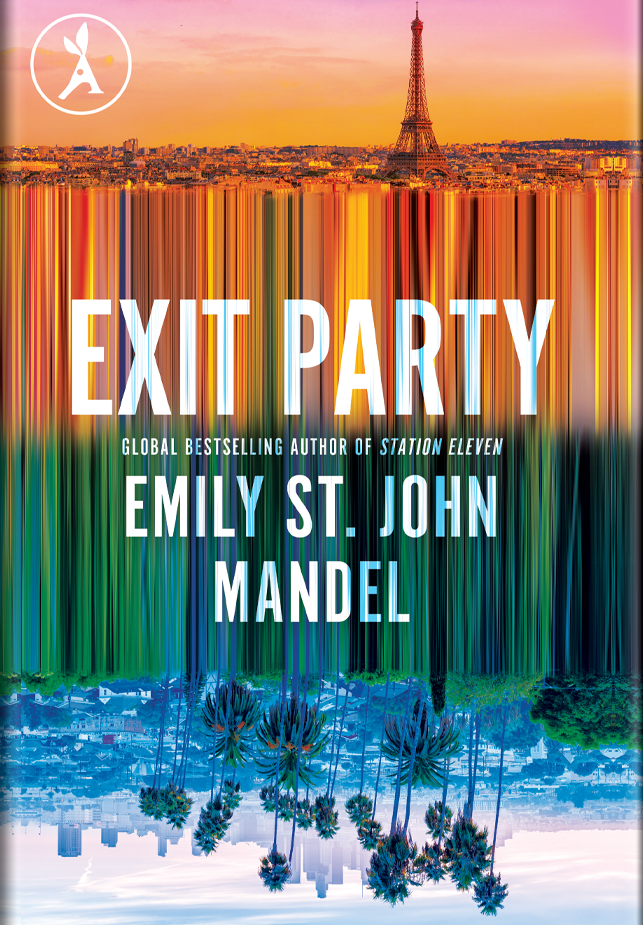
Exit Party

Emily St. John Mandel

Literary Fiction
Sci-Fi
LGBTQIA+

At a glance

🗓
Near-future setting
☣️
Dystopian
👯
Seeing double
👁
Multiple viewpoints

From the bestselling author of Station Eleven, Exit Party is Emily St. John Mandel’s epic new story of crimes committed and loves lost across worlds and decades.

2031. America is at war with itself, but for the first time in weeks there is some hope: the Republic of California has been declared, the curfew in Los Angeles is lifted, and everyone in the city is going to a party.

‍

Ari, newly released from prison, arrives with her friend Gloria just as a fragile new era begins. But there are people at the party who shouldn’t be there. Something is very wrong...

Years later, living a different life in Paris, Ari remains haunted by that night. Whatever happened at the party fractured her sense of reality – and may hold the key to a very different world.

‍

Freedom and surveillance, art and survival, love and loss in a broken world: Exit Party is the electrifying new novel from Emily St. John Mandel.

Don’t just take
our word for it

“Mandel always writes with clarity and precision. Her perceptive new dystopian novel explores what is lost in a rush to safety; it’s a hymn to what falls when the center doesn’t hold.”

- Library Journal (Starred Review) 🌟

“A glittering puzzle box of a novel . . . [The] novel brilliantly ties the notion of parallel timelines to a political theme, positing a dark twinship between chaos and totalitarianism. . . . This is [Mandel’s] best novel since Station Eleven, a cause for rejoicing among her fans and an inspiration for newbies to dive into the backlist. Both a thrilling read and a virtuoso demonstration of the moral and philosophical possibilities of speculative fiction.”

- Kirkus (Starred Review) 🌟

“As ever in her own wholly original and singular way, Mandel offers up a completely compelling, richly rendered yarn that's sure to generate both major interest and discussion.”

- Booklist (Starred Review) 🌟
Get a taste

In the first spring after the collapse of the United States, the blossoming of the jacaranda trees felt to Ari like grace. The trees bloomed in the same week that international peacekeeping troops withdrew from Los Angeles, and the convergence of flowers with the absence of foreign soldiers brought a delirious kind of hope. Everyone in the spring of 2031 knew the city was one terrorist attack away from disaster, but that peril made the season more vivid, not less.

‍

It was Ari’s first spring outside of prison in nearly two decades, and she spent hours at a time walking the streets. Prison is a wasteland of sensory deprivation, and now the city was overwhelming. She kept expecting that the details of the world would cease to be extraordinary, but that kept not happening. No one around her seemed to notice the jacarandas, because in Los Angeles there are flowers every month of the year, but she walked streets where the trees were lit up by purple-blue blossoms and thought, My god. This place. She was forty-eight years old but felt younger, because so much of the world was new.

‍

The United States had come undone following a coup d’état. Several states had seceded within a week of the coup, either alone or in alliances with neighbours, and war had broken out within the month. Now the fighting had subsided, for the most part, and Ari had been released into an uneasy aftermath.

‍

“When I think of what the city was a year ago,” Gloria said. Gloria was Ari’s roommate in a very small apartment in Echo Park. She was about a decade younger than Ari, a refugee who’d fled fighting between rival militias in Tennessee. Gloria slept in the bedroom. Ari slept in the living room, with an old sheet stapled to the door frame as a makeshift door, and they met one another in the tiny kitchen. Gloria seemed to spend most of her time reading the news online, her eyes wide and blank in the blue light of her laptop. What the city had been like a year ago was Gloria’s favourite topic of conversation.

‍

“I know,” Ari said gently, although she didn’t. Their experiences were not the same. A year ago, Ari had been imprisoned in what was now a different country and Gloria had been holed up in this apartment with a different roommate.

‍

But tonight the curfew had lifted, and when Ari had gone for a walk earlier, her impression from passing conversations was that everyone in Los Angeles was going out tonight. Gloria was going to her friend Kareem’s party, one neighbourhood over, and had invited Ari to come. But now, with dusk approaching, she’d settled into her familiar position with her laptop at the kitchen table, and showed no signs of getting ready.

‍

“What time shall we leave for that party?” Ari asked.

Want to join the Club?

Book notes

  • 🙋‍♀️ Why we chose

    We’ve learned from experience that when Emily St. John Mandel writes a dystopian novel, we better listen up. After the uncanny prescience of Station Eleven, when this author speaks, we pay attention. 

    Now on to Exit Party. The year is 2031, just after the collapse of the United States—a concerningly prompt, albeit believable timeline—and the reader is dropped into a world of civil war: divided states, peacekeeping troops, weapons dealers, and a heavy sense of unrest hanging over everything. 

    But it’s also a glittering world, one of glamorous soirees and high-end art collectors. The novel begins at a party celebrating the return to semi-normalcy (or the “new normal,” reminiscent of the post-Covid world that Mandel herself predicted), at which a striking woman wears a pleated silver dress. 

    And then…a change. A tonal slant, a dilation of genre. Realism hitches, a hiccup in regular space-time; we shift cleanly into the realm of the speculative, beyond even the scope of the book’s post-apocalyptic setting. Here, the story cleaves neatly in two, proliferating twins and doppelgangers, weaving a mystery of doubles to be unravelled.